Temuco
So Sunday I got back from one of the most amazing weeks of my life. We spent the last seven days in Chapod, a rural village near the city of Temuco. This is part of Mapuche territory, one of the indigenous groups of southern chile. We lived with a Mapuche family and spent the week learning about their culture and sharing with them. It was nine hours away by bus so we arrived early Sunday morning. The week was full of stuff so I'm going to go through each day so I don't forget anything.
Sunday
So we arrived very early sunday morning and were brought to the Escuela Municipal de Chapod. We had learned a greeting in Mapundungun: Mari Mari Lamgen. So we were able to greet the families with a Mapuche greeting. We were then introduced to our families, two SIT students per family. We then went with our families for the rest of the day to get to know each other and the area. I was paired with Tracy from the program and our family was amazing. Our mom and dad were and older couple. They had three daughters and a son. The oldest daughter is married and has a daughter, Belen, and had her own student living with her in a house down the road (the only boy Geoff lived with them). She teached 1st and 2nd grade at the public school in town. The two middle kids, Gemi and Damaris, are both studying psycopedagogoia (psychology) in Temuco but come home for the weekend. And the youngest son, Patricio or Pato/Patito for short, is thirteen and goes to school at the municiple school in the town. We found out later that Pato was adopted when he was 18 months old. Lioda, the oldest daughter was doing her teaching practicum when she met Pato as a baby. He had no parents and was in a really rough situation so her parents took them in as their own son. He is one of the coolest and nicest 13 year old boys I have ever met. He was super polite and very mature, asking us questions about university and life in the US. He is also super funny and loves goofing around with us.
The family is poor and lives in a small house made out of plywood. They have a wood stove and running water from an elevated bucket outside. But there is no hot water. There is a toilet in an outhouse but it connected to the side of the house. The house was very humble but it felt cozy and like home.
After we had a delicious breakfast of bread and jam and tea, we went with the family to the Evangelical church for sunday services. There were 8 SIT kids so the pastor welcomed us all and had us come tot he front to introduce ourselves. The music was very fun and lively and they had the words projected onto a screen so we could sing along. After church we went home and rested for a bit. We ate more bread with jam and some fresh eggs for dinner. Our family has sheep and chickens. And that afternoon while we were looking at the sheep, the family dog, Glot, came and attacked a lamb and tried to eat it. The family came out to stop it though before he could kill it and it was able to walk away with an injured leg.
At night we played cards and talked with the family. They were all very nice and loved exchanging stories. I was super excited to notice a difference in my level of spanish. I remember meeting my Santiago family and for a few weeks struggling to communicate stories about my life but here I noticed that it came a lot more naturally and I could talk candidly with my Mapuche family. I think I needed a change in scenery and pace to really notice how much I have improved. So that's super exciting!
The oldest daughter and her family and Geoff came over at night for dinner. It was cool to see such a big family together. Pretty much everyone in the town is interrelated somehow and family is very important to the Mapuche people. Its also cool to see families living so close in community. My family in the US is very spread out across the country in the northeast and Georgia and California so it was neat to have the entire family within walking distance.
Monday
Monday morning we got up really early and were driven to Lago Budi. This is now a tourist center but is a beautiful salt water lake that connects to the ocean. There are also two rukas set up there. Rukas are the traditional Mapuche house that are made out of would supports with palms covering it. Inside there was a fire going and breakfast set up for us. After, we brought our chairs outside and had our seminars outside looking at the lake. The first seminar was about Mapuche philosophy. We learned that 75% of Mapuches are protestant but there is a Mapuche religion that some still hold on to. Mapuche literally means "men of the earth" so we learned about the connectedness with the land and the spiritual side of the Mapuche people. I found this talk fascinating and a little sad that these beliefs were slowly being lost. We also learned about the history of the Mapuche people. Don Juan Pinecura gave the seminars, he is the director of the Temuco program for SIT.
Me at the ruka
We had a traditional Mapuche lunch and then had another seminar about Mapuches and tourism in a ruka. A lot of Mapuche people have begun to use tourism to their advantage to make money and educate people about their culture. Part of me agrees that it is a good idea for them to use tourism but another part of me feels like they are not really preserving their culture but are just putting on a show to make money.
That night Tracy and I showed our family pictures or our family and friends. They also showed us baby pictures and we got to hear a lot about their life. This was a really special night because we got to share so many stories.
Also, Monday was Justin's B-day and I was able to call him for a few minutes. It was expensive to call so we had to keep it short but it was great to wish him a happy 21st bday.
Tuesday
We spent Tuesday at the municipal school of Chapod. This school is only made up of about 30 kids in about 5 classrooms. Kinder and prekinder, 1st and 2nd, 3rd and 4th, 5th and 6th, and 7th and 8th. Susie, Ana, and I were together in the 1st and 2nd grade classroom in the morning to observe. The main focus of the week was intercultural and bilingual education so we were supposed to observe how this theme was addressed in the classroom. I was surprised to find that although they were learning a little bit of Mapudungun and about Mapuche culture, it was being taught as a foreign language rather than a native language. I went into this week thinking that Mapudungun was the main language and castellano was only a second language. But I was suprised to find that only my parents spoke Mapudungun but the kids did not. And in the school they were learning colors and animals in Mapudungun but were not able to communicate in the language.
We had recess and lunch with the kids and we started a big game of boys vs girls in basketball. It was a blast to play with the kids and it made it better that the girls won. In the afternoon we got to teach an English class in our classrooms. Since we had little kids we sang a bunch of English songs with them. We let them all pick very American names for the class, like Allison, Kate, and Dan. We first did body parts and sang "head shoulders, knees, and toes" and then played hokey pokey and then If you're happy and you know it. But we did that song in Spanglish to make it easier "Si tienes muchas ganas clap your hands". The kids had a lot of fun with the songs and dances. Then we did the Happy Birthday song. And finally we did animals with Old McDonald. But there are a lot of English words in that song, so we improvised and ended up writing Spanish lyrics. It turned out pretty well "todos tenemos animales e-i-e-i-o. Tenemos un pig/cow/dog e-i-e-i-o. Dice oink/moo/guau." and so on. ANd yes guau guau is the sound a dog makes in spanish (pronounced wow wow). It was a lot of fun and quite the adventure to make the songs into spanglish. And I hope the kids learned a little bit of English too. They also taught us some dances and songs that they like to sing in class.
After school, we had a lesson in Mapudungun. I was super excited to learn a little bit but found the language to be really difficult. It was very hard to learn a language that is not germanic or latin based. Also it was a crazy experience to learn another language in Spanish. We learned greetings, numbers, and family members. Its very interesting because the names for family members are different for maternal and paternal sides. For example, an aunt on your mom's side is Nukentu, while an aunt on your dad's side is Palu.
After all this long day, we met up with Patito and his friends afterschool and had a big soccer game. A lot of the people from the village came out to play with us and it was a lot of fun.
Wednesday
In the morning we met at Don Raul's house, the director of the school and my family's cousin. We met with all the kids of the school to help begin the construction of a ruka. It has been 70 years since a ruka was built in this community. They hope to have it finished by March of next year and have the SIT group help start it every semester. So next year 2 new rukas will be built. This construction also represents to continuation of the Mapuche culture because most Mapuche kids don't know how to build a ruka so while we were sharing in the culture, the adults are passing on the knowledge and culture to the next generation so that they can continue building rukas. It was a really moving thing to experience and be a part of. It was also really cool to learn about how the ruka must be built in relation to the sun. We worked all morning digging up dirt and moving to form the floor of the ruka. We then all enjoyed delicious sopa outside for lunch.
That afternoon we all gathered together on the soccer field to learn how to play Palin, the sport of the Mapuche. It is very similar to hockey but is played on a very small field. Eight players from each team line the field facing each other. The two in the center have a face off with the pelota ( a small, hard, wood ball). Everyone has a stick that is curved at the bottom and carved to be a little flatter on the side. The object is to get the ball to pass over the other teams end line. But if the ball is pushed out the side, it was to be brought back to the middle for a face off. I had a blast playing and it turns out I am pretty good at it too (haha who knew). But it is a very dangerous game. The ball is super hard and flies up in the air a lot when people smack their sticks against it. The ball just missed my face a couple of times. Also the field is very small and everyone has sticks so the ends were flying everywhere and it was very easy to get smacked in the shins with a stick. I was all bruised afterward but it was really fun and cool to learn another part of Mapuche culture. And of course afterward we played another big game of soccer. It was cool to play cause little 6 year old play and then really old grandpas play too. And they are all really good. Its amazing to see how much Futbol is a part of their culture and their life.
Thursday
We got in the bus again and traveled to Chol Chol another Mapuche town. We went to the Liceo Tecnica de Chol Chol, a technical, Catholic high school. We had two seminars given by the director of the school about the school and its philosophy as well as the politics of education. Both were very interesting and it was cool to see a school very different from the municipal school in Chapod. This school was very focused on intercultural education and is 90% Mapuche. Laura, Jackie, Sophie, and I got to visit a 2nd year creative writing class. A lot of times when we are put in classrooms, the conversations are really awkward and the students don't really show interest in us. But here, the students had tons of questions and seemed really excited to talk to us. There were 40 kids in the class os it was very overwhelming. But they were all really cool and wanted to be asked questions too. They told us that everyone had a lot of pride for their school and that they felt very fortunate to be there. And the only thing that they said they would change would be the uniforms. Then one of the girls read us her story.
As an important aside, I have learned that Chileans love chants. For the first few weeks I would notice that all of the sudden my family would start chanting something all together and then they would stop before I could figure out what was going on. I thought I was crazy until I learned in my spanish class that chanting is a very Chilean thing. What they do is make the chant in the form of a request using "que + the subjunctive of the verb" Now the subjunctive is one of the hardest things about spanish in my opinion because we don't really use it in English and it has a whole different conjugation. But Chileans love to use this chanting in the subjunctive. For example "que lo abra, que lo abra" is what they always chant when people get presents. Literally it means "that you open it" So once I learned that this chant thing is not just my family but a chilean thing, I have taken to chanting at random times too. It turns out that if you use the subjunctive correctly you can get your way a lot of times. One day in spanish we chanted "que no tengamos tarea" "that we don't have homework" and it worked. But anyways, I have been using it a lot when hanging out with my SIT friends. But my proudest moment came when we were in front of the creative writing class and they wanted one student to read her story to us, so I started the chant "que lo lea" and it caught on and everyone joined in. I was ecstatic that I had started a real chant and that is worked cause the girl read her story.
But I digress... Anyway, after the school we went to another ruka for a traditional Mapuche meal. Afterward, we took rides in the ox pulled wagon and went and explored the river nearby. It was a gorgeous day and it was a beautiful setting.
Next, we headed into the city of Temuco and had the afternoon free to explore the city and the artisan market. I was able to get a lot of gifts for family and friends. I also bought myself a pretty silver and lapilazuli bracelet (this blue stone is only found in Chile and one other country) and a red wool sweater. Both are hand-made by Mapuche so they are really cool to have and also look really nice too. I was informed by the owner of the sweater store that the red color of my sweater was perfect for my skin because I am so "blankita", basically super white. In case I didn't know already. Thanks...
Friday
In the morning we went to Don Juan's house and went into his ruka for our wrap-up seminar. We each gave a 5 minute presentation on a theme that we had explored during the week. I talked about bilingual education and how Mapudungun is being lost. I am getting more and more comfortable speaking spanish in front of a big group and although I had written notes for my presentation, I ended up just talking (yay). It was very interesting to hear all the different perspectives on the week. A lot of people talked about what does culture mean and what parts should be preserved. Sophie had a really good talk about the Machismo culture of the Mapuches and how much wome and girls are discriminated against (the boys were only selected to help plot out the ruka and only boys were asked to teach us Palin). It was a good way to wrap up the week. After we had a great lunch of finger foods made by Frank the assistant director who is a chef. Everything was amazing. That afternoon we of course played soccer with the people of the town again. And after we went with Pato and his friend to a waterfall and a river half an hour away. It was really beautiful and a great afternoon skipping rocks and relaxing by the river.
That night we went to Geoff's house to celebrate his birthday with him and his family. It was so sweet of them to through him a barbecue and I really felt at home among our big family. Afterward, we met the SIT group outside of the school to celebrate together. But there are no lights so we were just sitting in the dark in a circle outside of the school in the middle of no where just talking. It was so weird and unreal but really fun.
Saturday
We met at the school at 11 for a big Asado (bbq) with all of the families. Pato and four of his friends Ruli, Javier, Gustavo, and Pipe are in a musical group that plays Andean music. They have a cd that is professionally done and they are all very talented. The group played for us and we sang some songs together too. We all played basketball and knockout and cards until the food was ready. We had huge chunks of pork and beef and delicious salads. Afterward we played some more basketball and then had the finaly soccer tournament. My team lost in penalty kicks.
We went back to our house and went for a final walk around the campo with Patito. He showed us how to pick this mushroom like fruit that we had tried the day before. I ended up climbing up a fence with a giant stick to poke the fruit until they came raining down on my head. I also found a huge one and we picked it and brought it back for the family. Their land is so beautiful and it was so nice to take a final walk around. And although Patito stepped in a huge puddle and soaked his feet, he kept saying how he didn't want us to go. I felt really sad to be leaving and was surprised how attached I had become after only a week.
We had our last dinner together and I gave them one of my hand made thank you cards. Inside I explained that I wanted to thank them for everything. I told them I had learned a lot about Mapuche culture but they had shown me the most important part of Mapuche culture: family. They presented us with little key hooks to remember them by.
I also took that time to ask them if it would be ok with them if I returned in November for my independen study project. They said absolutely and Patito made me promise. It felt amazing to be part of the family after only one week. That night as we were saying goodbye to our families, I couldn't help but cry a little to leave them. I feel so lucky that I am going to have the opportunity to go back and I feel now that I left part of my heart in Chapod. I have never met such amazing people nor have I ever fallen in love with a place so quickly.
I talked to Frank the assistant director about doing my ISP there. I explained that I want to do something with special education, or language schools, or speech pathology. He told me he has 5 friends studying special education at a University, his mom teaches at a language school in Temuco, and his sister is a speech pathologist. He told me to email him and he will set me up. So I will have tons of contacts when I go back. I want to compare the special education system in temuco vs santiago so I will probably go back for a week or so. But I am extatic that there seems to be so much for me to research and that my family is waiting for me. My mom told me that we're going to go swimming in the river and have a picnic when I come back. I can't wait.
This week was truly unforgettable and I could talk forever about it. I don't know how to fully explain it but when you experience something that amazing, it is truly life changing. I know I am about as far as you get from an Indigenous chilean, but I really feel that part of me is with the Mapuche people.
 Alexis
 My Mapuche Family
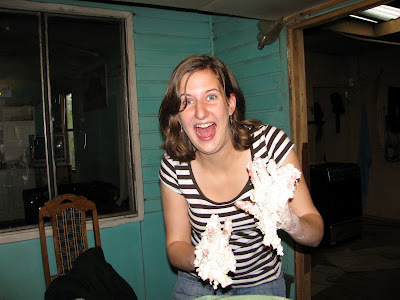
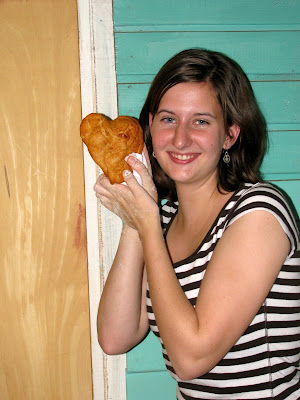
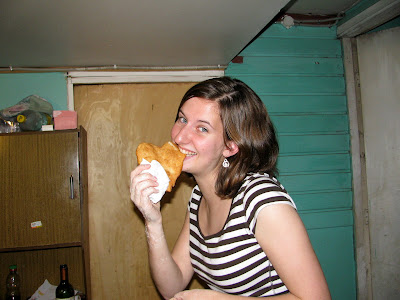
 Making bread